
Complete Affiliate Marketing Guide (Beginner to Advanced)
Introduction
If you’ve spent any time researching ways to earn money online, you’ve probably run into the term “affiliate marketing” more than once. It’s one of the most accessible online business models available today, and it’s a big reason why so many bloggers, YouTubers, and content creators are able to turn their websites into real income sources.
This complete affiliate marketing guide is designed to walk you through everything from the absolute basics to more advanced strategies. Whether you’re a total beginner who has never heard of a “cookie duration” or an intermediate marketer looking to sharpen your approach, you’ll find practical, no-fluff advice here.
Affiliate marketing has grown in popularity because it removes many of the traditional barriers to starting a business. You don’t need to create your own product, manage inventory, or handle customer service. Instead, you recommend products or services you believe in, and you earn a commission when someone purchases through your unique link.
This guide is written for beginners who want a clear starting point, as well as intermediate and advanced marketers who want to refine their strategy. By the end, you’ll understand how affiliate marketing works, how to choose a niche, how to build a website that converts, and how to avoid the mistakes that trip up most new affiliates.
What Is Affiliate Marketing?
Affiliate marketing is a performance-based marketing arrangement where a business rewards individuals (affiliates) for driving traffic or sales to their products through the affiliate’s own marketing efforts.
In simple terms: you recommend a product, someone buys it through your special link, and you earn a commission. No commission is paid unless a sale (or another defined action, like a sign-up) actually happens.
Key Participants in Affiliate Marketing
There are four main parties involved in every affiliate transaction:
- Merchant (Advertiser): The company or individual that creates and sells the product or service. This could be a large retailer, a software company, or a solo entrepreneur selling an online course.
- Affiliate (Publisher): That’s you. You promote the merchant’s products through your website, blog, YouTube channel, or social media.
- Customer: The person who clicks your affiliate link and makes a purchase or completes a desired action.
- Affiliate Network: A platform that connects merchants with affiliates, tracks clicks and sales, and handles payments. Not every program uses a network, but many do.
A Simple Step-by-Step Workflow
- You join an affiliate program or network related to your niche.
2. You receive a unique affiliate link or tracking code.
3. You create content (a review, tutorial, or comparison) that includes your affiliate link.
4. A reader clicks your link and is redirected to the merchant’s website.
5. A tracking cookie records that the visit came from you.
6. If the visitor buys something (often within a set time window), the sale is attributed to you.
7. You earn a commission, which is paid out according to the program’s schedule.
That’s the entire loop. It sounds simple because it is — but building a sustainable income from it takes strategy, patience, and consistent effort.
Benefits of Affiliate Marketing
Affiliate marketing remains popular for good reason. Here are the main advantages, along with a few realistic challenges you should know about upfront.
Benefits:
- Low startup cost: You don’t need to manufacture a product or hold inventory. A domain, hosting, and your time are often enough to get started.
- Flexible work schedule: You can build your affiliate business around a full-time job, school, or family commitments.
- Passive income potential: Once published, a well-optimized article can continue generating commissions for months or years with minimal upkeep.
- Scalability: You can promote unlimited products across multiple niches without the operational limits of a physical business.
- No customer service burden: The merchant handles order fulfillment, shipping, refunds, and support.
- Global audience reach: Content published online can reach readers anywhere, expanding your potential customer base far beyond a local market.
Realistic Challenges:
- Results take time. Most successful affiliate sites take months of consistent publishing before seeing meaningful traffic or income.
- Search engine algorithms change, which can affect your traffic.
- Building trust with an audience requires genuine expertise and honesty, not just a list of links.
- Income is not guaranteed and varies widely depending on niche, effort, and strategy.
Understanding both sides helps you set realistic expectations from day one.
How Affiliate Marketing Works
To succeed in affiliate marketing, it helps to understand the mechanics behind the scenes.
Affiliate Links and Tracking Cookies
An affiliate link contains a unique identifier tied to your account. When a user clicks the link, a tracking cookie is placed in their browser.. This cookie tells the merchant’s system, “This visitor came from Affiliate #1234.”
Cookie Duration
Cookie duration refers to how long that tracking cookie remains active. If a program has a 30-day cookie, you’ll still earn a commission if the visitor buys within 30 days of clicking your link — even if they don’t purchase immediately.
Commission Models
Different programs pay in different ways:
|
Commission Model |
How It Works |
Common Use Case |
|
Pay-Per-Sale (PPS) |
You earn a percentage of the sale price |
E-commerce, digital products |
|
Pay-Per-Lead (PPL) |
You earn when someone signs up or fills a form |
Software trials, insurance quotes |
|
Pay-Per-Click (PPC) |
You earn based on clicks, regardless of sale |
Rare; used by some ad-based networks |
|
Recurring Commission |
You earn repeatedly for as long as the customer stays subscribed |
SaaS and membership products |
Attribution Basics
Attribution determines who gets credit for a sale when multiple affiliates or channels were involved. Most programs use “last-click attribution,” meaning the affiliate whose link was clicked last before purchase gets the commission.
Payment Process
Affiliates are typically paid monthly, once they hit a minimum payout threshold. Payment methods vary and may include direct bank deposit, PayPal, or check, depending on the program.
Types of Affiliate Marketing
Not all affiliate marketing looks the same. There are generally three recognized approaches.
1. Unattached Affiliate Marketing
You promote a product with no real connection to it and no established authority in that niche — think of a generic banner ad. This approach requires little credibility but also tends to convert poorly and can feel spammy to audiences.
2. Related Affiliate Marketing
You promote products related to your niche and audience, even if you haven’t personally used them. For example, a tech blogger recommending a laptop accessory brand. This has more credibility than unattached marketing but still carries some risk if the product doesn’t perform as expected.
3. Involved Affiliate Marketing
You promote products you’ve personally used and can speak about with genuine experience. This is the most trustworthy and increasingly rewarded approach, especially given Google’s emphasis on first-hand experience in content quality.
Expert Tip: Affiliate marketing tends to perform best long-term because it builds real trust with your audience and aligns with what search engines now prioritize—genuine, experience-based content.
How to Choose a Profitable Niche
Picking the right niche is a crucial decision for your blog’s success. Get this right, and everything downstream — content creation, SEO, and monetization — becomes easier.
Passion vs. Profitability
Ideally, your niche sits at the intersection of what interests you and what has commercial demand. You don’t need to love your niche, but some baseline interest helps you stay consistent when growth feels slow.
Search Demand
Use keyword research tools to check whether people are actually searching for information in your potential niche. A niche with zero search volume will struggle to gain organic traffic no matter how good your content is.
Competition Level
Highly competitive niches (like “weight loss” or “make money online”) require significant time and authority to rank in search engines. Newer sites often do better starting with a narrower, less saturated niche.
Audience Problems
Effective affiliate content addresses a specific problem or need. Ask: What questions is my target audience asking?
Long-Term Potential
Choose a niche with room to grow. Avoid niches tied to short-lived trends unless you plan to pivot quickly.
Niche Examples:
- Home coffee brewing equipment
- Budget travel gear
- Beginner home fitness equipment
- Pet care for first-time dog owners
- Personal finance for young professionals
- Sustainable and eco-friendly products
Finding the Best Affiliate Programs
Now that you’ve chosen your niche, it’s time to explore affiliate programs that align with your audience and are worth promoting.
Company-Run Programs
Many brands run their own in-house affiliate programs, often with direct communication, better support, and sometimes higher commissions than third-party networks.
Affiliate Networks
Affiliate networks serve as platforms that connect numerous merchants with affiliates. They centralize tracking, reporting, and payments, making it easier to manage multiple programs from one dashboard.
What to Evaluate Before Joining a Program
- Commission rate: Higher isn’t always better if the product doesn’t sell well or has a low average order value.
- Cookie duration: Longer durations give you more opportunities to earn from the same click.
- Reputation: Research the merchant’s product quality and customer reviews. Promoting a poor-quality product damages your own credibility.
- Payment methods and minimum thresholds: Make sure the payout method and schedule work for you.
- Affiliate support: Responsive affiliate managers can help you troubleshoot tracking issues and access better promotional materials.
Avoid choosing programs based purely on commission percentage. A trustworthy product with a modest commission often outperforms a flashy product with a high commission but poor reviews.
Building an Affiliate Marketing Website
Your website is the foundation of most successful affiliate businesses. Here’s what to consider when setting one up.
Domain Name
Choose something short, memorable, and ideally reflective of your niche — without boxing yourself in too tightly if you plan to expand later.
Hosting
Reliable, fast hosting matters for both user experience and SEO. Slow-loading sites tend to lose visitors and rank lower in search results.
WordPress Setup
WordPress remains a popular choice for affiliate websites due to its flexibility, plugin ecosystem, and SEO-friendly structure.
Website Structure
Organize your site with clear categories so both readers and search engines can easily understand your content hierarchy.
Essential Pages
- Homepage
- About page
- Contact page
- Affiliate Disclosure page
- Privacy Policy page
Mobile Responsiveness and Speed
Most website visitors now access the internet through mobile devices. A responsive, fast-loading design isn’t optional — it’s essential for both user experience and search rankings.
Creating High-Quality Content
Strong content fuels successful affiliate marketing. Below are the content formats that typically perform well.
- Product Reviews: In-depth, honest evaluations based on real use or thorough research.
- Comparison Articles: Content that compares two products and guides readers toward the right choice.
- Buying Guides: Comprehensive resources covering everything a reader needs to know before purchasing.
- Tutorials: Step-by-step how-to content that naturally incorporates product recommendations.
- List Posts: “Best Products for X” roundups that are easy to scan and share.
- Resource Pages: A curated list of tools or products you personally recommend.
The common thread across all of these formats is genuine helpfulness. Content that prioritizes the reader’s decision-making process — rather than simply pushing a sale — tends to build more trust and perform better over time.
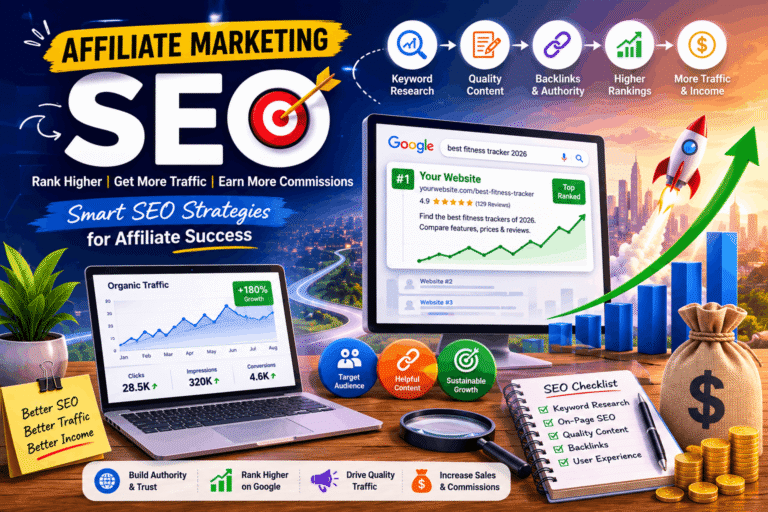
SEO for Affiliate Marketing
Search engine optimization is what brings free, ongoing traffic to your affiliate content.
Keyword Research
Identify the terms your audience is searching for, paying attention to search intent — are they looking to learn, compare, or buy?
Search Intent
Match your content format to intent. Someone searching “best running shoes for flat feet” wants a buying guide or comparison, not a generic blog post about running.
On-Page SEO
Optimize titles, headings, meta descriptions, and URL slugs with your target keywords, while keeping the language natural and reader-focused.
Internal Linking
Link related articles together to help visitors explore more of your site and to help search engines understand your site’s structure.
Technical SEO Basics
Ensure your site has a clean sitemap, fast load times, secure HTTPS, and no broken links.
Image Optimization
Compress images and use descriptive file names and alt text to improve both load speed and accessibility.
User Experience
Search engines increasingly reward sites that keep visitors engaged, so clear navigation, readable formatting, and helpful content all play a role in rankings.
Promoting Affiliate Content
Publishing content is only half the equation — you also need to get it in front of the right audience.
- Search Engines: Organic search remains one of the most sustainable, long-term traffic sources for affiliate sites.
- Email Marketing: Building an email list lets you nurture relationships and share recommendations directly, without relying solely on algorithms.
- Social Media: Platforms like Instagram, Facebook, and TikTok can drive traffic, especially when you share genuinely useful content rather than just links.
- Pinterest: Particularly effective for niches like home decor, recipes, fashion, and DIY, where visual content performs well.
- YouTube: Video reviews and tutorials can build trust quickly and often rank well in both YouTube and Google search results.
- Online Communities: Forums and niche communities can be valuable, but always follow community rules and prioritize genuine participation over self-promotion.
Expert Tip: The most sustainable promotion strategy focuses on providing value first. Audiences can quickly tell the difference between someone trying to help and someone trying to sell.
Affiliate Disclosure and Legal Compliance
Transparency isn’t just good practice — in many countries, it’s legally required.
Why Disclosures Matter
Readers deserve to know when a link may earn you a commission. This transparency builds trust rather than damaging it.
Building Reader Trust
A simple, honest disclosure statement shows readers you have nothing to hide, which can actually improve credibility rather than harm it.
Following Local Advertising Guidelines
Regulations regarding affiliate disclosures vary by country (for example, guidelines from the FTC in the United States or the CMA in the United Kingdom). Always research the specific requirements relevant to your audience and comply accordingly.
Privacy and Transparency
If you collect any visitor data (such as through email opt-ins or analytics), make sure you have a clear privacy policy explaining how that data is used.
Common Affiliate Marketing Mistakes
Steering clear of these common pitfalls can help you save valuable time and avoid unnecessary frustration.
- Choosing the wrong niche — Solution: Validate demand and competition before committing.
2. Publishing thin content — Solution: Prioritize depth and genuine helpfulness over word count alone.
3. Ignoring SEO fundamentals — Solution: Learn basic on-page SEO before publishing at scale.
4. Promoting low-quality products — Solution: Only recommend products you’d genuinely suggest to a friend.
5. Overusing affiliate links — Solution: Balance promotional content with genuinely informative, non-monetized content.
6. Ignoring analytics — Solution: Regularly review which content and links are actually converting.
7. Neglecting reader trust — Solution: Be transparent, honest, and disclose affiliate relationships clearly.
8. Expecting fast results — Solution: Treat affiliate marketing as a long-term business, not a quick win.
9. Relying on a single traffic source — Solution: Diversify between SEO, email, and social channels.
10.Failing to update old content — Solution: Revisit and refresh articles regularly to keep information accurate.
Best Practices for Long-Term Success
- Publish consistently: Regular publishing builds momentum and signals relevance to search engines.
- Build topical authority: Cover your niche comprehensively rather than publishing scattered, unrelated topics.
- Update content regularly: Outdated information (like discontinued products or old prices) can hurt both trust and rankings.
- Diversify affiliate programs: Don’t rely on a single merchant or network for all your income.
- Focus on user experience: A fast, easy-to-navigate site keeps visitors engaged longer.
- Track performance: Use analytics to understand what’s working and refine your strategy accordingly.
- Continue learning: SEO, consumer behavior, and platform algorithms evolve constantly — staying informed keeps your strategy relevant.
Conclusion
This complete affiliate marketing guide has walked you through the fundamentals of how affiliate marketing works, the different types of affiliate strategies, how to choose a niche, and how to build a website and content strategy that actually helps readers make decisions.
Affiliate marketing isn’t a get-rich-quick scheme — it’s a legitimate online business model that rewards patience, genuine expertise, and consistent effort. By focusing on helpful, honest content and following ethical promotion practices, you can build a sustainable affiliate business that grows steadily over time.
Start small, stay consistent, and keep your reader’s needs at the center of everything you create. That approach, more than any shortcut or trick, is what separates long-term affiliate success from short-lived attempts.
FAQ Section
1. What does affiliate marketing mean in simple language? Affiliate marketing is earning a commission by recommending someone else’s product using a unique tracking link, and getting paid only when a sale or action happens.
2. Is affiliate marketing good for beginners? Yes. It has a low startup cost and doesn’t require creating your own product, making it one of the more accessible online business models for beginners.
3. How much money can you make with affiliate marketing? Earnings vary widely based on niche, traffic, and effort. Some affiliates earn a small side income, while established sites can generate substantial revenue — but results are never guaranteed.
4. Can I start affiliate marketing without having a website? A website isn’t strictly required, but it gives you a long-term, owned platform for content, which tends to produce more consistent results than social media alone.
5. What is the best affiliate network for beginners? There’s no single “best” network — the right choice depends on your niche, audience, and the specific merchants you want to promote. Research a few options before committing.
6. How long does it take to make money from affiliate marketing? Most successful affiliate sites take several months to a year of consistent effort before generating meaningful income, largely due to the time it takes to build organic traffic.
7. Do I need to tell readers when I use affiliate links? Yes. Ethical practice and, in many countries, legal requirements mean you should clearly disclose when a link may earn you a commission.
8. What’s the difference between an affiliate network and an affiliate program? An affiliate program is run directly by a single merchant, while an affiliate network connects you to many merchants through one centralized platform.
9. Can I do affiliate marketing without a large audience? Yes. A smaller, highly engaged audience that trusts your recommendations can often convert better than a large but disengaged one.
10. What is the biggest mistake new affiliate marketers make? Many beginners publish thin, low-value content or promote products purely for high commissions rather than genuine relevance, which tends to hurt trust and long-term results.