
The Complete Guide to SEO (A Beginner to Advanced Guide)

Master Search Engine Optimization and Grow Your Website Organically
Introduction
The Complete Guide to SEO (Search Engine Optimization) is one of the most valuable digital marketing skills in today’s online world. Whether you own a personal blog, an eCommerce store, a business website, or a service-based company, SEO helps people find your website through search engines like Google, Bing, and Yahoo without paying for advertisements.
Many beginners believe SEO is complicated, but the truth is that anyone can learn it by understanding the fundamentals and applying the right strategies consistently. Updated SEO is no longer about simply stuffing keywords into articles. Instead, it focuses on creating helpful content, providing a great user experience, building trust, and making websites easy for search engines to understand.
This guide will walk you through everything from beginner concepts to advanced SEO strategies using simple, professional English that readers from the United States, Canada, the United Kingdom, Australia, and other English-speaking countries can easily understand.
What is SEO?
SEO (Search Engine Optimization) is the process of improving your website so that it appears higher in search engine results when people search for relevant topics.
For example:
If someone searches for:
Best SEO agency
Local SEO services
WordPress SEO guide
How to rank on Google
Google will display websites it believes provide the best answers.
Your goal is to become one of those websites.
Better rankings usually lead to:
More website visitors
Higher brand awareness
More leads
More sales
Long-term business growth
Unlike paid advertising, SEO continues bringing visitors even after your content has been published.
Why is SEO Important?
Millions of searches happen every single day.
People search before they buy products, hire services, read reviews, or solve problems.
If your website appears on the first page of Google, you have a much better chance of attracting customers than websites hidden on page two or beyond.
Benefits of SEO include:
Free organic traffic
Better brand credibility
Higher conversion rates
Improved user experience
Long-term marketing results
Better return on investment
Competitive advantage
SEO is a long-term investment that delivers lasting value and results over time.
How Search Engines Work
Before diving into SEO, it’s necessary to understand how search engines perform.
There are three main steps.
- Crawling
Search engines use automated bots (called crawlers or spiders) to discover pages across the internet.
They follow links from one page to another and collect information.
- Indexing
Once a page is discovered, search engines analyze its content and store it in their database (called the index).
If a page isn’t indexed by search engines, it won’t appear in search results.
- Ranking
When someone searches for something, Google evaluates thousands of pages and ranks the most useful, trustworthy, and relevant results at the top.
Many ranking factors influence this decision.
Types of SEO
SEO consists of several different areas.
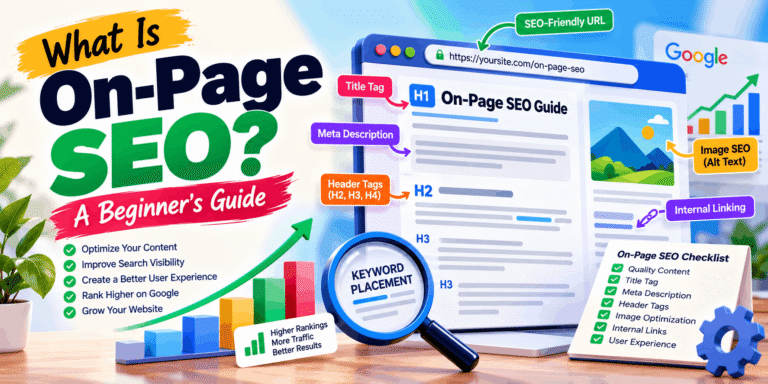
On-Page SEO
This focuses on optimizing the content and HTML elements of your website.
Examples include:
Keyword optimization
Title tags
Meta descriptions
Header tags
Internal linking
Image optimization
Content quality
Off-Page SEO
Off-page SEO involves activities outside your website that improve authority.
Examples:
Backlinks
Brand mentions
Guest posting
Digital PR
Social sharing
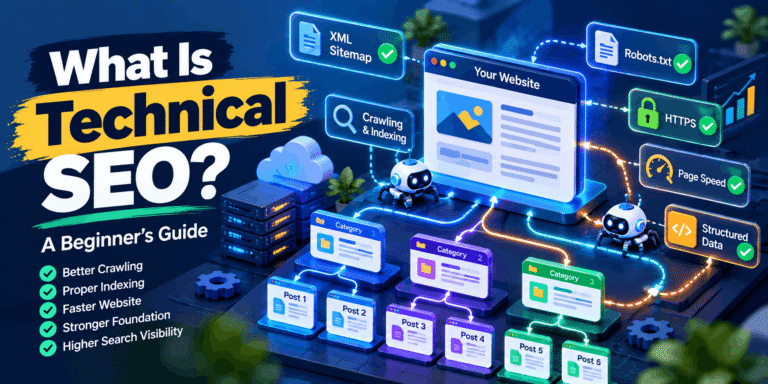
Technical SEO
Technical SEO helps search engines crawl, interpret, and understand your website efficiently.
It includes:
Website speed
Mobile friendliness
XML sitemaps
Robots.txt
HTTPS security
Structured data
Crawl optimization
Local SEO
Local SEO helps businesses appear in location-based searches.
Examples include:
Google Business Profile optimization
Local citations
Customer reviews
Location pages
Local keywords
Perfect for:
Restaurants
Dentists
Law firms
Contractors
Home services
Medical clinics
Keyword Research
Keywords are the words people type into search engines.
Good keyword research helps you create content that users actually search for.
There are different types of keywords.
Short-tail Keywords
Examples:
SEO
Marketing
Hosting
These usually have high competition.
Long-tail Keywords
Examples:
Best SEO tools for beginners
Local SEO tips for small businesses
How to optimize WordPress for Google
Long-tail keywords typically have lower competition and can lead to higher conversion rates.
Search Intent
Every keyword has an intent.
Understanding search intent is one of the biggest SEO success factors.
The four common search intents are:
Informational
Users want to learn.
Example:
How does SEO work?
Navigational
Users want to find a specific website.
Example:
Google Search Console
Commercial
Users compare products before buying.
Example:
Best SEO software
Transactional
Users are ready to purchase.
Example:
Buy SEO audit service
Always match your content to the user’s intent.
Creating High-Quality Content
High-quality content remains one of the most important factors influencing search engine rankings.
High-quality content should:
Solve a real problem
Answer common questions
Be easy to read
Include examples
Stay updated
Be original
Provide value
Avoid writing only for search engines.
Write for real people first.
On-Page SEO Best Practices
Every page should include several important SEO elements.
SEO Title
Write a compelling title with your primary keyword.
Example:
Complete SEO Guide for Beginners (2026)
Meta Description
Summarize your page in about 150–160 characters.
Encourage users to click.
URL Structure
Keep URLs short and descriptive.
Good:
example.com/seo-guide
Bad:
example.com/post?id=8748934
Heading Structure
Use headings logically.
H1
H2
H3
H4
This improves readability.
Internal Links
Connect related pages together.
Benefits:
Better navigation
Stronger SEO
Longer visitor sessions
Easier crawling
External Links
Link to trustworthy sources when appropriate.
This improves credibility.
Image SEO
Images also contribute to SEO.
Best practices include:
Compress image sizes
Use descriptive file names
Add ALT text
Choose modern formats
Use responsive images
Fast-loading images improve user experience.
Technical SEO Essentials
A technically healthy website ranks more easily.
Focus on:
Fast loading speed
HTTPS security
Mobile responsiveness
XML sitemap
Robots.txt
Canonical URLs
Structured data
Broken link fixes
Technical SEO creates the foundation for successful rankings.
Mobile SEO
Most internet users browse on mobile devices.
Google primarily evaluates the mobile version of websites.
Ensure your website:
Loads quickly
Has readable fonts
Uses responsive design
Features clickable buttons
Avoids intrusive pop-ups
A mobile-friendly website improves both rankings and user satisfaction.
Website Speed Optimization
Speed is animportantranking factor.
Ways to improve speed include:
Compress images
Enable browser caching
Use aCDN
Minify CSS and JavaScript
Choose quality hosting
Remove unnecessary plugins
Even a one-second improvement can positively impact user engagement.
Link Building
Backlinks remain one of Google’s strongest ranking signals.
A backlink is a link from another website pointing to yours.
Quality matters much more than quantity.
Good backlinks come from:
Industry blogs
News websites
Educational websites
Trusted directories
Business partnerships
Avoid buying spammy backlinks.
E-E-A-T: Building Trust
Google values websites that demonstrate:
Experience
Expertise
Authoritativeness
Trustworthiness
You can improve E-E-A-T by:
Publishing accurate information
Showing author credentials
Keeping content updated
Using secure HTTPS
Displaying contact information
Earning positive reviews
Trust is increasingly important in modern SEO.
Common SEO Mistakes
Many beginners unknowingly make mistakes that hurt rankings.
Avoid:
Keyword stuffing
Duplicate content
Thin articles
Slow websites
Broken links
Ignoring mobile users
Missing title tags
Poor internal linking
Low-quality backlinks
Outdated content
Fixing these issues often leads to noticeable improvements.
Measuring SEO Performance
SEO requires continuous monitoring.
Key metrics include:
Organic traffic
Keyword rankings
Click-through rate (CTR)
Bounce rate
Average engagement time
Conversion rate
Indexed pages
Backlink growth
Regular analysis helps identify opportunities for improvement.
Helpful SEO Tools
Many excellent SEO tools are available.
Popular options include:
Google Search Console
Google Analytics
Google Keyword Planner
Ahrefs
SEMrush
Screaming Frog
Moz
Ubersuggest
Even beginners can achieve great results using free tools.
Advanced SEO Strategies
Once you’ve mastered the basics, consider advanced techniques.
These include:
Topic Clusters
Instead of publishing unrelated articles, create groups of related content connected through internal links.
This builds topical authority.
Content Refreshing
Update older articles regularly by:
Adding new information
Improving examples
Updating screenshots
Expanding sections
Refreshing statistics
Fresh content often performs better.
Schema Markup
Structured data helps search engines understand your content.
It can increase your chances of earning rich results like:
FAQs
Reviews
Recipes
Products
Events
Core Web Vitals
Google evaluates user experience through performance metrics such as:
Loading speed
Visual stability
Interactivity
Improving these metrics benefits both users and rankings.
Content Silos
Organize your website into logical categories.
Example:
SEO
→ Keyword Research
→ On-Page SEO
→ Technical SEO
→ Link Building
→ Local SEO
This structure improves navigation and authority.
How Long Does SEO Take?
SEO is a long-term strategy.
Generally:
1–3 months: Technical improvements and indexing
3–6 months: Early ranking improvements
6–12 months: Significant traffic growth
12+ months: Strong authority and sustainable results
The exact timeline depends on:
Competition
Content quality
Website age
Backlink profile
Technical health
Industry
Consistency is the key.
The Future of SEO
SEO continues evolving every year.
Future trends include:
AI-assisted search
Voice search optimization
Visual search
Better user experience
Helpful, people-first content
Stronger brand authority
Personalized search experiences
Businesses that prioritize helpful content over shortcuts will continue to succeed.

Final Thoughts
The Complete Guide to SEO is not about tricking search engines—it is about helping people find valuable information. By understanding how search engines work, creating useful content, improving your website’s technical performance, and building authority over time, you can achieve sustainable organic growth.
Whether you are launching your first website, running an online store, offering professional services, or building a personal brand, SEO remains one of the most effective long-term digital marketing strategies available.
Start with the fundamentals, stay consistent, monitor your progress, and continue learning as search engines evolve. Every optimized page you publish becomes another opportunity to attract visitors, build trust, and grow your business.
Remember, successful SEO is a marathon—not a sprint. Focus on delivering genuine value to your audience, and the rankings will follow.