
What Is SEO, Really? A Down-to-Earth Guide for Beginners
What is SEO? Ever notice how some websites always seem to show up on the first page of Google, while others — even ones with genuinely useful content — get buried on page five? That’s not luck. In most cases, the issue can be traced back to SEO.
SEO stands for Search Engine Optimization, and if you run a blog, a small shop, an online store, or even just a personal site, understanding it can make a real difference in whether people actually find you.
Let’s walk through what it is, how it works, and how you can start using it — even if you’ve never touched it before.
So, What Is SEO Exactly?
At its core, SEO is about shaping your website so search engines can understand what it’s about and show it to the right people at the right time.
Here’s a simple way to picture it: say you own a small bakery in Toronto. A user types “best bakery in Toronto” into the Google search bar. SEO is what determines whether your site shows up on that search — or gets lost among a hundred competitors.
Unlike running ads, you’re not paying for that spot. You’re earning it, through solid content, a website that actually makes sense to navigate, and a good overall experience for whoever lands on your page.
How Search Engines Actually Find You
Google and other search engines don’t magically “know” your site exists. They go through a process, roughly in three stages:
Crawling — Bots (called crawlers) roam the web, following links and discovering new or updated pages.
Indexing — Once a page is found, Google reads through it and files away what it’s about in a massive database, sort of like a library catalog.
Ranking — When someone runs a search, Google sorts through everything it knows and decides which pages best answer that particular query. The better your content aligns with search intent, the greater its potential to rank higher.
Good SEO simply gives your site a better shot at standing out during that ranking step.
Why Bother With SEO At All?
It’s fair to ask — why put in the effort? A few reasons stand out:
You get more visitors without paying for every single click
Your brand starts to feel more credible and established
The changes you make often improve the experience for actual visitors, too
It brings in people who are already looking for what you offer, not just random traffic
The results tend to stick around, unlike ads that stop the moment you stop paying
The catch is that it builds up gradually. Once your site starts ranking well, though, that visibility tends to compound over time.
The Different Flavors of SEO
People usually break SEO down into a few categories. Here’s the gist of each.
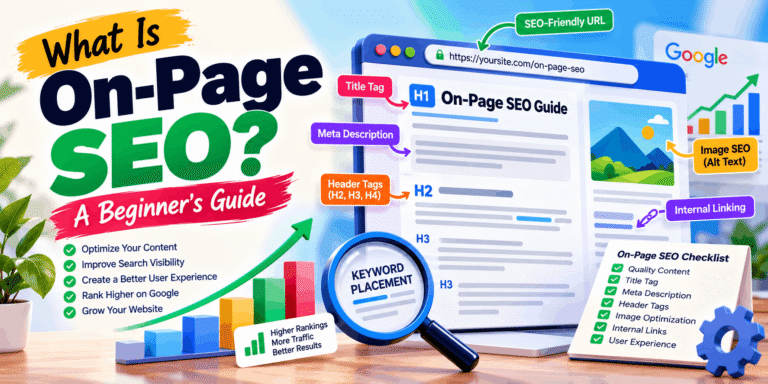
On-Page SEO
This is everything happening directly on your website — the words, structure, and layout of each page. Think writing content people actually want to read, choosing clear page titles, writing meta descriptions that describe what’s really there, using headings that make sense, optimizing your images, and linking to other pages on your own site.
Technical SEO
This is the behind-the-scenes stuff. A site that loads quickly, works well on phones, runs on HTTPS, has a proper sitemap, uses clean URLs, and doesn’t have a trail of broken links is a site Making it easier for search engines to crawl and understand your website. Get this right and everything else works better too.
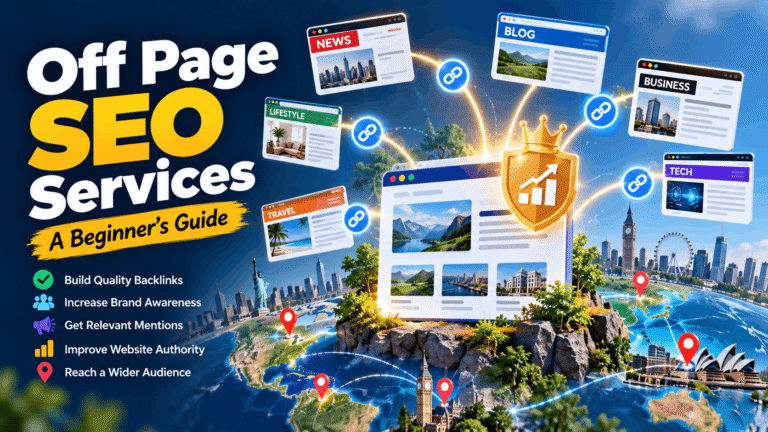
Off-Page SEO
Not everything that helps your ranking happens on your own site. Backlinks from other trustworthy sites, people mentioning your brand, coverage from other publications, and shares on social media all signal to Google that you’re a source worth trusting.
Local SEO
If you run a business that serves a specific area — a dentist in Sydney, a coffee shop someone’s searching for nearby, a roofer in Texas — local SEO is what helps you show up for those “near me” and city-specific searches. It usually means keeping your business listings accurate and gathering genuine customer reviews.
What an Effective SEO Strategy Really Looks Like
There’s no single trick that does all the work. It’s really a handful of things working together:
Write content that’s genuinely useful, not just filler. Do some keyword research so you understand what people are actually typing into Google. Keep your site easy to navigate, with pages that load fast. Make sure it works just as well on a phone as it does on a laptop, since most visitors are probably browsing on mobile anyway. Connect your website’s related pages through relevant internal links. And don’t just publish something once and forget about it — revisit your older content and keep it accurate.
Mistakes That Trip Up Beginners
A lot of these are easy to fall into without realizing it:
Copying content from somewhere else instead of writing your own
Cramming keywords in unnaturally, hoping it’ll help (it usually backfires)
Ignoring that the majority of people access websites from their phones
Publishing short, thin pages that don’t really say much
Writing clickbait-y titles that don’t match what’s actually on the page
Skipping image optimization
Not linking related pages together
Expecting to rank on page one within a week
SEO rewards patience more than cleverness. There’s rarely a shortcut.
How Long Before You See Results?
Honestly — it depends. Your competition, how good your content already is, and your industry all play a role. Some sites see movement in a few weeks; others take several months before anything noticeable happens.
The one thing that reliably helps is consistency: keep publishing, keep improving your site, and keep an eye on how things are performing.
SEO vs. Paid Ads — Which Strategy Is Better?
They aren’t direct competitors; each one serves a different purpose. Paid ads get you visibility immediately, but the moment you stop paying, that traffic disappears. SEO takes time to build, but once established, it can continue generating organic traffic inwithout an ongoing bill for every visitor.
A lot of businesses end upusing both — ads for the short-term push, SEO for the long game.
If You’re Just Getting Started
A few practical starting points:
Learn the fundamentals before chasing advanced tactics
Write for actual humans first, then adjust for search engines
Stick to one main topic per page — don’t try to cram everything in
Use headings that make your content easy to scan
Keep things fast-loading and mobile-friendly
Link to your own related content where it’s relevant
Keep an eye on Google Search Console and Analytics to see what’s actually working
Stay curious, because SEO keeps changing
The Bottom Line
SEO isn’t about outsmarting Google. It’s really about making your site genuinely easier to use and easier to find — which, when you think about it, is what any visitor wants anyway.
There’s no overnight fix. But if you keep publishing things that are actually helpful, keep your site running smoothly, and stay focused on what your audience needs, the results tend to show up on their own — and they stick around longer than a paid ad ever would.
Quick FAQ
What does SEO stand for? Search Engine Optimization — improving a site so it shows up more in search results.
Is SEO free? You don’t pay Google directly to rank, but it does cost you time, and sometimes tools or outside help.
How long until I see results? Usually a few months, though it varies a lot depending on your niche and competition.
Can a total beginner learn this? Yes, honestly. Start with the basics, stay consistent, and it clicks faster than you’d expect.
Why should a business even care about this? Because it brings in people who are already looking for what you sell — without the recurring cost of ads.