
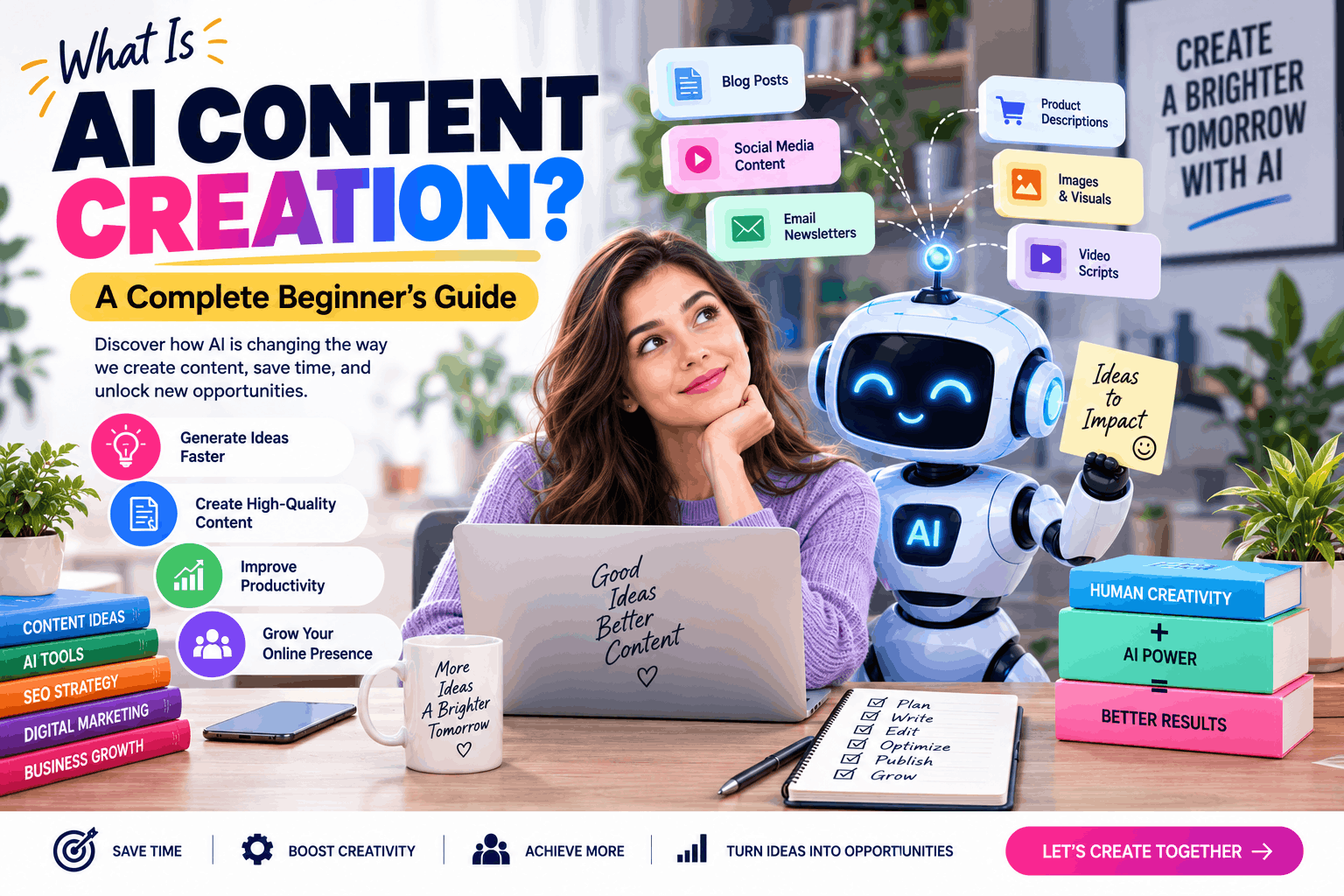
What Is AI Content Creation? A Complete Beginner’s Guide
If you’ve spent any time online in the last couple of years, you’ve probably noticed a lot more content being published, faster than ever. Blogs, social captions, product descriptions, even entire video scripts are showing up at a pace that would have been impossible a few years ago. A big part of that shift comes down to one thing: AI content creation.
Whether you’re a blogger trying to publish more consistently, a small business owner juggling marketing on your own, or a student curious about how this technology actually works, understanding AI content creation is quickly becoming a useful skill. It’s not just a trend for tech insiders anymore — it’s a practical tool that everyday creators are using to save time and work smarter.
In this guide, we’ll break down exactly what AI content creation is, how it works, and why so many creators and businesses are adopting it. We’ll also cover its benefits, its limitations, popular tools, and how to use AI responsibly so your content stays trustworthy and genuinely helpful to readers. By the end, you’ll have a clear, practical understanding of the topic — no technical background required.
What Is AI Content Creation?
So, what is AI content creation, exactly? In simple terms, it’s the process of using artificial intelligence tools to help generate, improve, organize, or transform content — things like blog posts, captions, emails, or images.
These tools rely on natural language processing (NLP) and machine learning, which are technologies that allow computers to understand human language patterns and produce text that reads naturally. Instead of a computer just following rigid rules, it’s been trained on huge amounts of text so it can generate new sentences that make sense in context.
Here’s a simple example. Say you type a prompt like, “Write a friendly Instagram caption for a coffee shop’s new pumpkin spice latte.” An AI writing tool will analyze that request and generate a caption that matches the tone and topic you asked for. You then read it, tweak it if needed, and post it.
That’s the essence of AI content creation: a human gives direction, and the AI produces a starting point — or sometimes a nearly finished piece — that the human then reviews and refines.
How Does AI Content Creation Work?
You don’t need to understand the technical details of machine learning to use these tools effectively, but it helps to know the basic process. Here’s how it typically works:
- You provide a prompt or instructions. This could be a simple sentence or a detailed brief with tone, audience, and length requirements.
2. The AI analyzes your request. It looks at the words, context, and any examples you’ve given to understand what you’re asking for.
3. The AI generates or improves content. Based on patterns it learned during training, it produces text, suggestions, or edits.
4. You review and edit the result. This step is essential — AI output is a draft, not a finished product.
5. The final content gets published or used. Once it’s been checked and polished, it’s ready for your blog, social media, or marketing materials.
Think of it like working with a very fast, very well-read assistant who can draft things quickly but still needs your judgment to make sure everything is accurate, on-brand, and genuinely useful.
Types of Content AI Can Create
AI content generator tools can now assist with a wide range of formats. Some of the most common include:
- Blog posts and articles
- Social media captions and posts
- Product descriptions for ecommerce
- Email newsletters
- Video scripts and outlines
- SEO titles and meta descriptions
- Advertisements and marketing copy
- Website copy, like homepage or About pages
- Content ideas and topic brainstorms
- Images and visual concepts
Some tools specialize in one area, like writing, while others combine several capabilities — for example, generating both text and accompanying images.
Benefits of AI Content Creation
There’s a reason AI writing tools have become so popular among bloggers, marketers, and small business owners. Here are some of the most meaningful benefits:
It’s worth repeating, though: AI does not replace human expertise. It’s a tool that supports your work — the judgment, experience, and creativity still need to come from you.
Limitations and Risks of AI Content Creation
No tool is perfect, and it’s important to go in with realistic expectations. Some common limitations include:
- Incorrect information. AI can generate facts that sound convincing but are wrong — sometimes called “hallucinations.”
- Generic writing. Without guidance, AI output can feel bland or interchangeable with countless other pieces.
- Lack of personal experience. AI hasn’t lived through anything, so it can’t share genuine first-hand insight.
- Outdated information. Depending on the tool, its knowledge may not reflect the most recent events or data.
- Bias. AI models can reflect biases present in their training data.
- Copyright concerns. It’s important to avoid publishing content that closely mirrors existing copyrighted material.
- Overdependence on AI. Relying on it too heavily can weaken your own writing and critical thinking skills over time.
The practical fix for most of these issues is simple: always fact-check, always edit, and always add your own perspective before publishing anything.
Popular AI Content Creation Tools
There are several categories of AI content tools worth knowing about:
- AI writing assistants – tools like ChatGPT and Claude help draft and refine text based on prompts.
- AI research tools – used to summarize information or find relevant sources.
- AI image generators – tools like Canva AI can create custom visuals from text descriptions.
- AI video tools – used to generate scripts, captions, or even basic video edits.
- AI grammar and editing tools – tools like Grammarly AI help polish tone, clarity, and correctness.
- AI SEO tools – help with keyword research and optimizing content structure.
Different tools have different strengths, so many creators use a combination rather than relying on just one.
How to Use AI for Content Creation
If you’re ready to try AI for content creation, here’s a simple, beginner-friendly workflow:
- Define your target audience.
2. Choose a specific content topic.
3. Research the subject so you understand the basics yourself.
4. Write a clear, detailed prompt.
5. Generate a first draft using an AI writing tool.
6. Check facts carefully against reliable sources.
7. Add personal insights, experience, or opinions.
8. Edit and improve the tone, flow, and clarity.
9. Optimize the content for SEO.
10. Publish, then monitor and update the content over time.
Following this process helps you get the speed benefits of AI while still producing content that’s accurate, original, and genuinely valuable to readers.
AI Content Creation vs. Traditional Content Creation
Understanding the differences between AI-assisted and fully traditional (human-only) content creation can help you decide when to use each approach.
|
Factor |
AI Content Creation |
Traditional Content Creation |
|
Speed |
Very fast first drafts |
Slower, more time-intensive |
|
Creativity |
Pattern-based, can feel generic |
Original, deeply personal |
|
Research |
Limited to training data or connected tools |
Can include first-hand investigation |
|
Human experience |
None |
Rich, authentic |
|
Accuracy |
Requires fact-checking |
Depends on the writer’s diligence |
|
Editing |
Still requires human review |
Often self-edited throughout |
|
Best use cases |
Drafts, outlines, repetitive content |
Opinion pieces, personal stories, expert analysis |
In most cases, the most effective approach blends both: AI handles the heavy lifting of drafting, while human creativity and experience shape the final, polished piece.
Common Mistakes Beginners Make
If you’re new to AI content creation, watch out for these common pitfalls:
- Publishing AI content without editing. Solution: always review and revise before hitting publish.
2. Using vague prompts. Solution: be specific about tone, audience, and length.
3. Not checking facts. Solution: verify claims, statistics, and names against reliable sources.
4. Copying AI output blindly. Solution: rewrite sections in your own voice where needed.
5. Ignoring the target audience. Solution: tailor prompts and edits to who will actually read the content.
6. Keyword stuffing. Solution: use keywords naturally, only where they make sense.
7. Failing to add original insights. Solution: include your own experience, examples, or opinions.
8. Depending entirely on AI. Solution: Treat AI as a support tool rather than replacing your expertise and decision-making.
Avoiding these mistakes is one of the easiest ways to make sure your content stays high-quality and trustworthy.
Best Practices for Responsible AI Content Creation
To get the most out of AI while keeping your content credible, keep these best practices in mind:
- Use AI as a helpful assistant, not as a substitute for your own judgment.
- Add your own experience and opinions to every piece.
- Verify important facts, statistics, and claims.
- Maintain originality — avoid closely copying existing content.
- Protect confidential or sensitive information when using AI tools.
- Follow copyright rules, especially with AI-generated images or quotes.
- Prioritize your readers’ needs over shortcuts.
- Review every piece of content carefully before publishing.
Responsible AI use isn’t just good practice — it’s what keeps your audience’s trust intact over the long run.
Conclusion
So, what is AI content creation? At its core, it’s the use of artificial intelligence to help generate, refine, and organize content — from blog posts to social captions to product descriptions. It offers real benefits, like saving time, sparking ideas, and boosting productivity, especially for bloggers, small business owners, and freelancers who wear many hats.
At the same time, AI comes with certain limitations. It can get facts wrong, sound generic, and lack the personal experience that makes content genuinely compelling. That’s why human oversight — fact-checking, editing, and adding your own voice — remains essential.
If you’re new to this space, the best approach is to start experimenting. Try a few tools, test different prompts, and always review what comes out. Used thoughtfully, AI can become a valuable part of your content creation process, without ever replacing the judgment and creativity that only you can bring.
FAQ Section
1. What is AI content creation in simple terms? It’s the use of artificial intelligence tools to help write, edit, or generate content like blog posts, captions, and product descriptions.
2. Is AI-generated content safe to publish? Yes, as long as it’s fact-checked, edited, and reviewed by a human before publishing.
3. Can AI replace human writers? No. AI can speed up drafting, but human judgment, creativity, and experience are still essential for quality content.
4. Which AI writing tools are best suited for beginners? Tools like ChatGPT, Claude, and Grammarly AI are popular starting points for beginners.
5. Does using AI content hurt SEO rankings? Not inherently. What matters most is whether the content is helpful, accurate, and well-edited — not whether AI was involved in drafting it.
6. Is AI content plagiarism? Not automatically, but closely copying AI output without review or originality checks can create plagiarism risks. Always refine AI-generated content and add your own unique voice.
7. How much editing does AI content need? Most AI drafts need fact-checking, tone adjustments, and the addition of personal insights before they’re ready to publish.
8. Can small businesses benefit from AI content creation? Yes. AI tools can help small businesses and freelancers produce consistent content without needing a full marketing team.
9. What are the biggest risks of AI content creation? Incorrect information, generic writing, and lack of personal experience are the most common risks to watch for.
10. How do I start using AI for content creation? Start with a clear topic and audience, write a detailed prompt, generate a draft, then fact-check and personalize it before publishing.
