
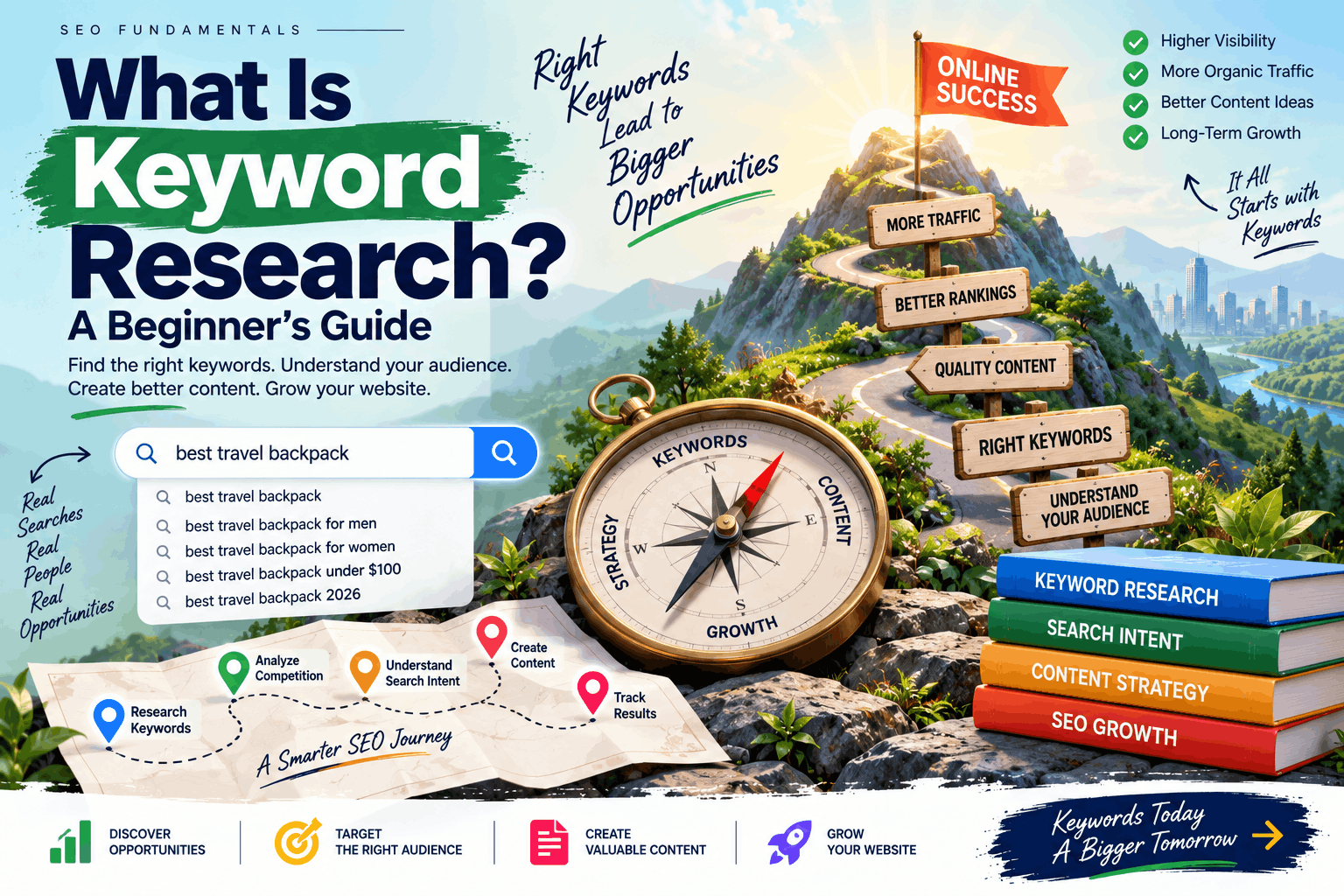
What Is Keyword Research? A Beginner’s Guide to Choosing the Right Keywords
Introduction
If you’ve ever wondered how some websites always seem to show up on the first page of Google, the answer usually starts with one thing: keyword research. It’s the process of figuring out exactly what words and phrases your audience types into search engines, so you can create content that actually reaches them.
For beginners, this might sound technical or intimidating. It isn’t. At its core, keyword research is just about understanding your readers a little better before you start writing.
In this guide, you’ll learn what keyword research is, why it matters, the different types of keywords you’ll come across, and a simple step-by-step process for finding the right ones. By the end, you’ll have a practical foundation to start planning content with confidence.
What Is Keyword Research?
So, what is keyword research exactly? In simple terms, it’s the process of discovering the words and phrases people search for when they’re looking for information, products, or services online.
Every time someone opens Google and types something in, that search is a clue. Keyword research helps you collect and organize those clues so you can create content that answers real questions people are already asking.
Here’s a simple example. Let’s say you manage a small bakery blog. Instead of guessing what to write about, keyword research might show you that people frequently search for “how to make sourdough bread at home” or “best banana bread recipe.” Now you have real topics, backed by real demand, instead of a guess.
Why Is Keyword Research Important?
Skipping keyword research is like opening a shop without knowing whether local customers actually want what you’re selling. Here’s why it matters:
- Understanding your audience. Keywords reveal what your readers actually care about, in their own words.
- Finding content opportunities. You’ll spot topics your competitors haven’t covered yet.
- Improving search visibility. Targeting the right terms helps search engines understand what your page is about.
- Attracting relevant traffic. You get visitors who are actually interested in what you offer, not just random clicks.
- Supporting content planning. A solid keyword list becomes the backbone of your content calendar.
- Understanding search intent. It helps you match the type of content to what searchers actually want.
- Avoiding topics with little demand. You save time by not writing about things nobody is searching for.
Types of Keywords
Not all keywords work the same way. Understanding the different types helps you build a more balanced content strategy.
Short-tail keywords are broad, usually one or two words, like “keyword research” or “coffee maker.” They tend to have high search volume but are very competitive.
Long-tail keywords are longer, more specific phrases, like “best keyword research tools for beginners.” They usually have lower search volume but are easier to rank for and attract more targeted visitors.
Informational keywords are used when people want to learn or find information about something, such as “what is keyword research.”
Navigational keywords are used when someone is looking for a specific website or brand, like “Ahrefs login.”
Commercial investigation keywords show up when someone is comparing options, such as “Semrush vs Ahrefs.”
Transactional keywords indicate that a user is ready to make a purchase, such as “buy keyword research tool subscription.”
Branded keywords include a specific brand name, such as “Google Keyword Planner.”
Non-branded keywords don’t mention any brand, like “free keyword research tool.”
What Is Search Intent?
Search intent refers to what a person wants to find when they search online. Understanding it is just as important as finding the keyword itself, because it tells you what kind of content to create.
There are four main types:
- Informational Intent – The searcher is looking for knowledge or answers, such as “what is search intent.”
2. Navigational intent – The searcher wants to reach a specific site (e.g., “Semrush website”).
3. Commercial intent – The searcher is comparing products or services before deciding (e.g., “best SEO tools 2026″).
4. Transactional intent – The searcher is ready to take action, like making a purchase (e.g., “buy Ahrefs subscription”).
If you write a product page for a keyword that actually has informational intent, you’ll likely see high bounce rates and low conversions. Matching content type to intent is one of the simplest ways to improve results.
Important Keyword Metrics
When you’re evaluating keywords, a few metrics help you make smarter decisions.
|
Metric |
What It Means |
Why It Matters |
|
Search Volume |
How many times a keyword is searched monthly |
Shows potential audience size |
|
Keyword Difficulty |
How hard it is to rank for a keyword |
Helps you set realistic goals |
|
Competition |
How many sites are targeting the same keyword |
Indicates ranking difficulty |
|
Cost Per Click (CPC) |
Average cost advertisers pay per click |
Signals commercial value |
|
Traffic Potential |
Estimated total traffic a ranking page could get |
Broader view than volume alone |
|
Relevance |
How closely the keyword matches your content |
Ensures the right audience finds you |
It’s worth repeating: search volume alone should never be the deciding factor. A keyword with lower volume but strong relevance and intent match can outperform a high-volume keyword that doesn’t fit your content.
A Step-by-Step Guide to Keyword Research
Here’s a beginner-friendly process you can follow:
- Define your niche. Know exactly what your website or business focuses on.
2. Understand your target audience. Think about their questions, problems, and goals.
3. Create seed keywords. Begin with broad topics that are relevant to your niche.
4. Find related keyword ideas. Expand your seed keywords using tools or search suggestions.
5. Analyze search intent. Check what type of content currently ranks for each keyword.
6. Check keyword difficulty. Look for keywords that match your website’s current authority.
7. Evaluate search volume. Balance volume with relevance and competition.
8. Study competitors. Find out which keywords similar websites are ranking for.
9. Choose realistic keywords. Prioritize keywords you can actually compete for.
10. Organize keywords into content topics. Group related keywords to plan articles efficiently.
Best Keyword Research Tools
You don’t need an expensive toolkit to get started. Here are some commonly used options:
Beginners can absolutely start with free tools like Google Search and Search Console before investing in paid platforms.
How to Choose the Right Keywords
Once you have a list of keyword ideas, here’s how to narrow it down:
- Match keywords with your audience’s actual needs.
- Prioritize relevance over raw search volume.
- Consider search intent before committing to a keyword.
- Target realistic competition levels, especially early on.
- Use long-tail keywords to build momentum.
- Focus on keywords that support your business goals.
- Avoid keyword stuffing at all costs.
For example, a new blog might struggle to rank for “recipes,” a broad and highly competitive short-tail keyword. Instead, targeting “easy 30-minute dinner recipes for beginners” is far more achievable and still attracts genuinely interested readers.
Common Keyword Research Mistakes
- Choosing keywords only by search volume. Solution: Balance volume with relevance and intent.
2. Ignoring search intent. Solution: Check what type of content currently ranks before writing.
3. Targeting overly competitive keywords. Solution: Start with long-tail keywords that match your site’s authority.
4. Using irrelevant keywords. Solution: Stick to topics that genuinely fit your niche.
5. Keyword stuffing. Solution: Write naturally and let keywords fit the context.
6. Ignoring long-tail keywords. Solution: Include them for quicker, more realistic wins.
7. Not researching competitors. Solution: Study what’s already ranking to find gaps.
8. Targeting the same keyword on multiple pages. Solution: Assign one primary keyword per page.
9. Forgetting to update keyword research. Solution: Review and update your keyword list every few months.
10. Focusing only on one keyword. Solution: Include related keywords to cover a topic more fully.
Keyword Research for Different Website Types
Keyword research isn’t one-size-fits-all. Here’s how it varies depending on your website:
- Blogs often focus on informational keywords, like “how to start a blog.”
- Affiliate websites benefit from commercial investigation keywords, like “best budget laptops.”
- eCommerce stores should prioritize transactional keywords, like “buy running shoes online.”
- Local businesses need location-based keywords, like “plumber in Manchester.”
- Service websites often target a mix of informational and transactional keywords, like “how much does website design cost.”
Best Practices for Keyword Research
- Focus on genuine user needs, not just rankings.
- Use natural, conversational language in your content.
- Group related keywords together instead of treating each as separate.
- Build topic clusters around core subjects for stronger authority.
- Review search engine results pages (SERPs) regularly, since they change over time.
- Update your keyword lists periodically to stay relevant.
- Always combine keyword research with genuinely helpful, well-written content.
Conclusion
Keyword research is really about understanding people, not just chasing numbers. When you know what your audience is searching for and why, you can create content that genuinely helps them, which is exactly what search engines reward over time.
Use this guide as a starting point: define your niche, explore keyword ideas, check search intent, and choose keywords that realistically fit your website’s current stage. Treat keyword research as an ongoing part of your content strategy rather than a one-time task, and you’ll build a stronger, more sustainable foundation for organic traffic.
FAQ Section
1. What is keyword research in SEO?
Keyword research involves identifying the words and phrases people search for online so you can create content that meets their needs.
2. Why Should Beginners Learn Keyword Research?
It helps beginners understand their audience and avoid guessing what topics to write about, saving time and improving results.
3. How Do Short-Tail and Long-Tail Keywords Differ?
Short-tail keywords target broad topics with high competition, whereas long-tail keywords are more specific and usually face less competition.
4. How Can I Find the Right Keywords for My Website?
Start with seed keywords related to your niche, then expand them using search suggestions, keyword tools, and competitor research.
5. Is Search Volume the Most Important Factor in Keyword Research?
No. Relevance and search intent matter just as much, sometimes more, than raw search volume.
6. How Can I Do Keyword Research for Free?
Yes. Tools like Google Search, Google Search Console, and Google Trends are free and useful for beginners.
7. What Does Search Intent Mean, and Why Does It Matter?
Search intent refers to what a user is trying to find when they search. Matching your content to that intent can help improve search visibility and user satisfaction.
8. How Frequently Should I Refresh My Keyword Research?
It’s a good idea to review your keyword list every few months, since search trends and competition change over time.
9. What is keyword difficulty?
Keyword difficulty measures how hard it is to rank for a particular keyword based on existing competition.
10. Are Expensive Tools Necessary for Keyword Research?
Not at all. Many beginners get great results using free tools before investing in paid platforms like Ahrefs or Semrush.


